Midland Border East Skillnet
The Midland Border East Skillnet works with its members to identify and drive training and upskilling in the Retail, Sales, Manufacturing, Childcare and Construction sectors, to meet business, people, and performance needs of our members. In particular, we encourage and support the development of training programmes to meet existing and future needs within these sectors to drive Workforce design,
People Development and Strategic Innovation and where possible to support those seeking employment to development skills and work placement opportunities within their sector of employment. Our members include multinationals, large, medium, small Irish companies.
Upcoming Training
Programs

This programme covers a wide range of disciplines, including:
– Energy Efficiency & Renewable Technologies – Learn how to optimize energy use and integrate solar, wind, and other renewables.
– Building Services Engineering & Smart Systems – Gain expertise in HVAC, lighting, and advanced automation for intelligent buildings.
– Sustainability & Environmental Impact – Develop strategies for reducing carbon footprints and enhancing building performance.
– Data Analytics & Energy Auditing – Master the latest tools for monitoring, measuring, and managing energy consumption.
– Regulations & Policy Compliance – Understand national and international energy standards that shape the industry.
PLEASE NOTE: THE PRECISE START DATE FOR THIS SEPTEMBER COURSE IS YET TO BE CONFIRMED. PLEASE ENSURE YOU CHECK WITH US FOR EXACT DATES.
This Midland Border East Skillnet course is co-funded by the Government of Ireland and the European Union
Start Date
Duration
Location

PLEASE NOTE: THE PRECISE START DATE IN SEPTEMBER IS YET TO BE CONFIRMED, 7th SEPTEMBER SHOULD BE USED AS A GUIDE ONLY. PLEASE ENSURE YOU CHECK WITH US FOR EXACT DATES.
This Midland Border East Skillnet course is co-funded by the Government of Ireland and the European Union
Start Date
Duration
Location

PLEASE NOTE: THE PRECISE START DATE IN SEPTEMBER IS YET TO BE CONFIRMED, 6th SEPTEMBER SHOULD BE USED AS A GUIDE ONLY. PLEASE ENSURE YOU CHECK WITH US FOR EXACT DATES.
Data Analytics is the process of examining vast quantities of data, often referred to as Big Data, in order to draw conclusions and insights about the information they contain. Some examples of Data Analytics applications include real-time fraud detection, complex competitive commercial analysis, website optimisation, intelligent air, road and other traffic management and consumer spending patterns.
Big Data presents three primary problems: there’s too much data to handle easily; the speed of data flowing in and out makes it difficult to analyse; and the range and type of data sources are too great to assimilate. With the right analytics and techniques, these big data can deliver hidden and unhidden insights, patterns and relationships from multiple sources using Data Analytics techniques.
TUS Athlone, has developed an industry-focused, contemporary masters programme that will equip graduates with the skills and aptitudes necessary to excel in the emerging field of Big Data and Data Analytics. This programme will ensure that you will be able to understand the data context, apply appropriate techniques and utilise the most relevant tools to generate insights into such data.
The programme runs over two calendar years, commencing in September, consisting of four semesters. Semesters 1, 2 and 3 will incorporate three key pillars of data analytics: Data, Tools & Techniques and Analysis. Each pillar overlaps with the other to provide a coherent and unified set of core skills in data analytics. Semester 4 will consist of a substantive research project. Classes are delivered online across two evenings a week – Monday’s 7pm-9pm and Wednesday’s 7pm-9pm.
At the core of the discipline is data. In this pillar, students will develop their skills in areas including database technologies, data manipulation languages including SQL and the R programming language. In order to understand the data, a range of techniques will be taught, including programming for Big Data, statistics and probabilities and the interpretation of data. Interwoven within these modules is the use of industry-standard data analytics software tools. The final pillar of the programme is analysis. In these modules, students will develop skills to become data-savvy practitioners, gaining insights into data from which strategic decisions can be made.
Applied Research Project: In Semester 4 of the programme, students will be required to undertake a data analytics project and associated thesis of 20,000 words.
Start Date
Duration
Location
Featured Company
Chadwicks
Chadwicks Group is Ireland’s leading builders’ merchanting company. Thanks to our unrivalled knowledge and expertise in the construction sector, we have been part of the fabric of everyday life in Ireland for over 200 years, providing building materials to homes, hotels, farms, transport networks and every other form of business throughout the country.

















Skillnet Ireland 2021/2025
Skillnet Ireland has launched its Strategy 2021-2025. Our key focus for the next 5 years is how we can transform business through talent in the areas of Workforce Planning, People Development and Strategic Innovation. https://www.skillnetireland.ie/strategy2025#TalentTransformsBusiness

Investing in Our Workforce
Meeting the objectives of this Statement of Strategy is predicated on Skillnet Ireland developing an increased funding base. Currently, Skillnet Ireland operates on the basis of two income sources:
1) Contributions from businesses participating in Skillnet Ireland programmes, and;
2) Allocations from the employer-funded National Training Fund (NTF).
In 2019, employers contributed over €22 million to the cost of Skillnet Ireland programmes, with every €100 of exchequer investment in the Training Networks Programme attracting a further €117 in private investment. Our ability to leverage private sector investment to this extent is a compelling element of the Skillnet Ireland model and costsharing with employers is a principle the agency is fundamentally committed to.
The National Training Fund (NTF) reform programme is also central to this Statement of Strategy. As recommended under the NTF reforms, Skillnet Ireland is giving businesses and employers a direct voice in determining NTF priorities and we look forward to working with colleagues in Government to further advance this objective over the coming years.
Stakeholder Consultation & Strategic Themes
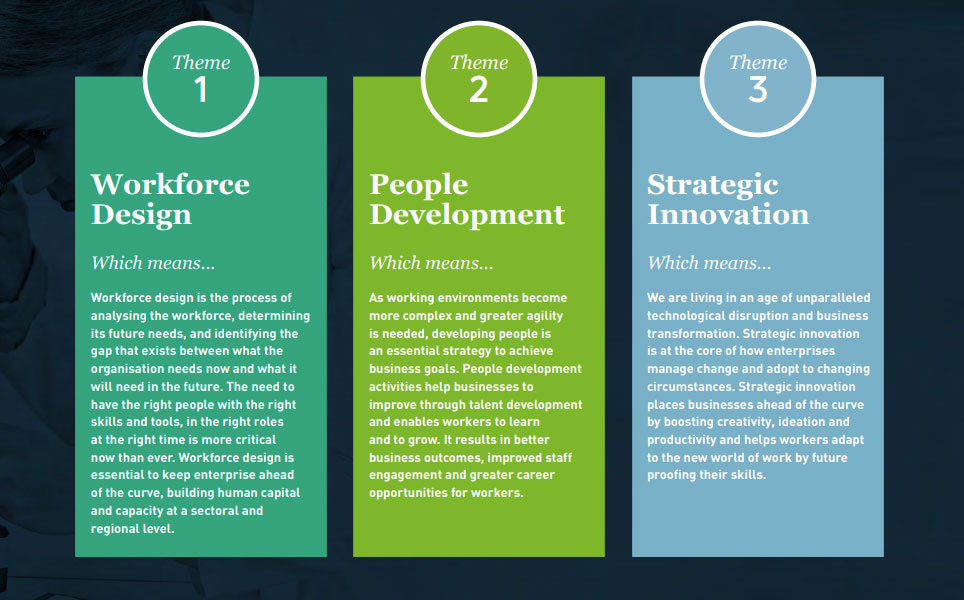
This Statement of Strategy is informed by an extensive multistakeholder consultation spanning government, state agencies, industry bodies, worker representatives and the general public. Consultations were conducted in 2019 and again in 2020 to take account of the impact of Covid-19. Three strategic themes were
highlighted through the consultation process:
1) Workforce Design
2) People Development
3) Strategic Innovation